China Best Phone Power Station Manufacturer and Supplier
China has become a major sourcing center for reliable mobile charging equipment. A capable Phone Power Station manufacturer combines engineering, production control, and practical user feedback. The product should do more than charge several phones. It should organize cables, reduce desk clutter, and remain dependable during busy hours.
Steven Yang, founder of Anker Innovations, has said, “Reliable technology should make everyday life simpler.” This idea fits the Phone Power Station market closely. A well-designed unit can support offices, hotels, schools, events, retail counters, and public service areas. It may include multiple charging ports, USB-C fast charging, smart power distribution, LED indicators, and replaceable cables. Small details matter. A loose connector can damage user confidence quickly.
Experienced Chinese suppliers normally inspect components before assembly. They test charging stability, heat performance, enclosure strength, and long operating cycles. They also review packaging, labeling, and shipment protection. Reliable manufacturers can provide OEM and ODM development, factory samples, technical documents, and responsive after-sales support. Certifications and regional compliance should be verified for each target market, not assumed from a similar product.
No factory is flawless. That deserves honest attention. Production delays, connector wear, or unclear specifications can still appear. Strong suppliers reduce these risks through documented inspections and transparent communication. Buyers should request samples before large orders. They should also confirm output capacity, warranty terms, customization limits, and delivery schedules.
Choosing the right China Phone Power Station manufacturer means evaluating evidence, not attractive photographs. Consistent quality, practical design, and accountable service create lasting supplier value. Not every low-priced option is economical. Sometimes, the cheapest unit becomes the most expensive mistake.
What Is a Phone Power Station?
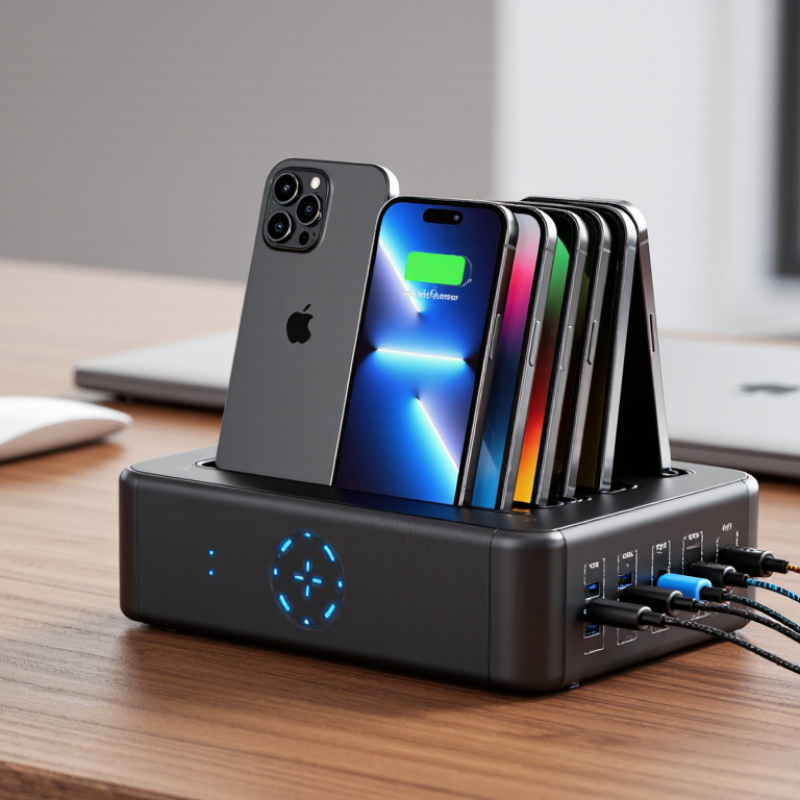
A phone power station is a compact battery system designed to recharge phones away from wall outlets. It usually combines a rechargeable cell, charging ports, power management, and sometimes wireless output. Unlike a simple power bank, it may support several devices, show remaining capacity, and accept solar or vehicle input. The term is still fuzzy. Some sellers use it for a large power bank, while others mean a small emergency charging hub. This difference matters when comparing capacity and output.
Demand is practical, not theoretical. GSMA Intelligence reported about 4.7 billion mobile internet users worldwide in 2023. Reliable charging therefore matters during travel, field work, and outages. Grand View Research has projected strong growth for the portable power station market.
A useful phone station should state watt-hours, USB output, recharge time, cycle life, and battery chemistry. Look for protection against overcharge, overheating, short circuits, and excessive discharge. Evidence such as IEC 62133-2 and UN 38.3 testing improves supplier credibility.
In real use, a 10,000 mAh label does not equal 10,000 mAh delivered. Conversion losses reduce usable capacity. Cable quality matters too. Capacity claims are sometimes treated as guaranteed runtime, which is an easy mistake. Buyers should test one sample under load before placing a large order. Reliable sourcing begins with measurable specifications, not attractive pictures.
Key Features of a Reliable Phone Power Station
Key Features of a Reliable Phone Power Station
A reliable phone power station starts with honest capacity. A 20,000mAh label can sound impressive, but conversion losses reduce usable energy. Check watt-hours, output efficiency, and tested runtime instead. GSMA Intelligence’s The Mobile Economy 2024 estimates 4.7 billion people used mobile internet in 2023. A dependable backup therefore needs stable power, not just a large battery number.
Look for USB-C Power Delivery, intelligent current control, and protection against overheating, overcharging, and short circuits. Multiple ports help during travel or field work, but shared output can reduce charging speed. Small details matter. A clear display should show remaining energy, output watts, and charging status. I prefer readable figures over decorative lights. The IEC 62133-2 standard provides safety requirements for portable sealed secondary lithium cells, so documented testing deserves attention. Certification claims should be verifiable.
Battery durability also affects real value. Ask whether the stated capacity reflects laboratory conditions or usable output. IDC’s Worldwide Quarterly Mobile Phone Tracker recorded about 1.17 billion smartphone shipments in 2023, showing how widely portable charging supports daily communication. Still, bigger is not always better. A heavy unit may remain unused in a drawer. My own evaluation would include cable compatibility, recharge time, fan noise, and performance after repeated cycles. Manufacturers should publish these results clearly, even when the numbers are less flattering.
How to Choose a China-Based Manufacturer and Supplier
How to Choose a China-Based Manufacturer and Supplier
Choosing a China-based phone power station manufacturer requires more than comparing prices. Examine factory experience, production equipment, and quality-control procedures. Request clear specifications for battery capacity, charging speed, ports, cycle life, and safety protection. Ask for product samples before discussing large orders. Test charging stability, heat levels, casing strength, and performance with several phone models. Do not trust factory photos alone.
A dependable supplier should provide relevant test reports and explain compliance requirements for your target market. Confirm the battery cell source, battery management system, inspection process, and traceability records. Check whether the factory can manage small trial orders and later production increases. This reveals more than a polished sales presentation. Communication matters too. Measure response speed, technical accuracy, packaging details, lead times, payment terms, and after-sales support.
Price still matters, but an unusually low quote may hide weaker cells or limited testing. One practical lesson is to calculate the complete landed cost, including samples, packaging, freight, duties, and possible rework. No evaluation is perfect. I once underestimated how much labeling changes could delay delivery. A written agreement should define tolerances, warranty handling, replacement procedures, and inspection rights. Visit the facility when possible, or use an independent inspection service. A supplier that welcomes questions usually offers stronger long-term cooperation.
Manufacturing Standards, Customization, and Quality Control
China’s power station manufacturers must prove more than capacity claims. Reliable production begins with controlled materials and documented procedures. Incoming cells are checked for voltage, internal resistance, and visible damage. Each battery pack should include protection against overcharge, over-discharge, short circuits, and excessive temperature.
Standards guide the process. Applicable safety requirements, transport testing, and electromagnetic compatibility checks should be considered before mass production. A professional supplier also maintains lot numbers, inspection records, and sample retention. During assembly, technicians verify welding points, insulation, connector alignment, and enclosure strength. Aging tests can reveal unstable charging behavior that a quick functional test may miss.
Customization should be practical, not decorative. Buyers may request different capacities, USB-C power delivery, display layouts, mounting methods, or firmware settings. These changes require engineering validation, not only a revised drawing. A small pilot run helps confirm heat distribution, charging speed, and user handling. It also exposes weak assumptions. No factory process is perfect. A connector may fit correctly but feel fragile after repeated use. That detail deserves correction before shipment. Final inspection should include full-load testing, repeated charging cycles, drop checks, and clear packaging verification. Consistent records make quality measurable and help customers trust each production batch.
China Best Phone Power Station Manufacturer and Supplier
Manufacturing Standards, Customization, and Quality Control
Manufacturing Standards
Commonly referenced requirements include UN 38.3 for lithium battery transport testing, IEC 62133-2 for portable sealed secondary lithium cells, IEC 62368-1 for electrical and electronic equipment safety, and IEC 60529 for IP protection ratings.
Customization
Product options may include battery capacity, USB-C Power Delivery profiles, AC output configuration, display language, enclosure design, connectors, and packaging specifications.
Quality Control
Typical inspections cover incoming cells and components, battery management system verification, insulation and withstand-voltage testing, charging and discharging performance, thermal protection, appearance, and final functional testing.
The chart shows the standardized fixed USB Power Delivery voltage profiles of 5 V, 9 V, 15 V, and 20 V. Actual product support depends on the selected controller, power source, cable, and final product design.



 WS Kate
 Weshare Power Bank