How to Choose the Best Phone Power Station?
Choosing the best Phone Power Station is less about chasing the largest battery. It is about matching dependable power with real daily needs. A compact station may charge a phone several times, fit inside a backpack, and remain useful during travel or short outages. A larger model can support laptops, cameras, routers, or medical accessories, but it adds weight, cost, and charging time.
Energy-storage analyst Julian Jansen offers a practical reminder: “The best battery storage system is the one that fits the user’s needs.” That principle should guide every comparison. Check the usable capacity, not only the advertised watt-hours. Review USB-C output, charging speed, solar compatibility, battery chemistry, display accuracy, and safety protections. A 100-watt USB-C port matters if your laptop depends on it. It does not help much if your cable supports only 20 watts.
Look closely.
Real experience also exposes small weaknesses. Some displays appear precise but estimate remaining power poorly under heavy loads. Some stations feel portable until a long walk begins. Noise, heat, warranty support, and replacement policies deserve attention too. I may prefer a lightweight Phone Power Station for ordinary travel, yet choose a heavier unit for emergency home use. There is no perfect model. The right choice depends on your devices, charging habits, environment, and tolerance for compromise. This guide compares those details clearly, so you can choose power that works beyond a product photograph.
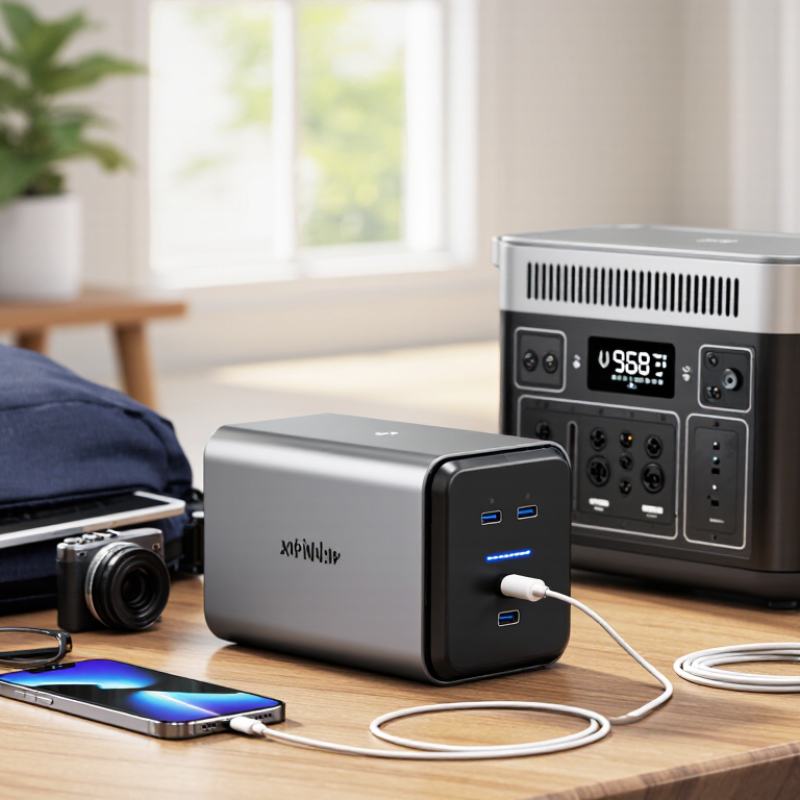
Understanding What a Phone Power Station Is and How It Works
A phone power station is a rechargeable battery system designed to store energy and deliver it through USB outputs. It is more than a simple emergency charger. Inside, a battery management system monitors voltage, temperature, and current during charging. A power conversion circuit then changes stored energy into the voltage your phone requires. USB Power Delivery can negotiate suitable voltage and current between compatible devices, cables, and chargers.
The numbers make this useful. GSMA Intelligence estimated that 4.7 billion people used mobile internet in 2023. A dependable backup battery therefore supports work, navigation, communication, and safety during long days. Capacity deserves careful checking. A 10,000 mAh cell rated at 3.7 volts stores about 37 watt-hours, before conversion losses. Real usable energy may be lower. I have found that advertised capacity can feel confusing in daily use. Cable quality, phone temperature, and charging speed also affect results. That distinction matters.
When choosing one, check output power, port type, thermal protection, and cycle life. Higher wattage does not always mean faster charging. Your phone must accept it. The Global E-waste Monitor 2024 reported 62 million tonnes of electronic waste in 2022, with only 22.3% formally recycled. A durable power station with replaceable cables may reduce unnecessary waste. Solar input sounds attractive, but weak indoor light often produces little energy. I would test the station with your own phone before relying on it during travel or outages. Small is not weak. Oversized is not automatically better.
How to Choose the Best Phone Power Station? - Understanding What a Phone Power Station Is and How It Works
Estimated full smartphone charges by usable power-station capacity
The estimates use a typical smartphone battery of 4,500 mAh at 3.85 V, equal to approximately 17.3 Wh.
They assume an average 85% charging efficiency, so the estimated number of full charges is calculated as
usable capacity × 0.85 ÷ 17.3 Wh. Actual results vary with battery size, charging losses, cable quality,
temperature, and power-station output limits.
Comparing Battery Capacity, Output Speed, and Port Compatibility
Choosing a phone power station starts with usable capacity, not the largest printed number. A 10,000 mAh battery stores roughly 37 Wh at a typical 3.7 V rating. After conversion losses, only about 29 Wh may reach your phone. For a 4,500 mAh phone, that usually means around 1.5 full charges. My first estimate was too optimistic. Cable quality, temperature, and battery age changed the result. The Battery University technical guide also notes that lithium-ion capacity declines with cycle use and heat.
Output speed matters when your phone is nearly empty. USB Power Delivery specifications support profiles up to 240 W, according to the USB Implementers Forum. Most phones need far less, often between 18 W and 65 W. Higher power is not automatically better. The phone controls its charging rate. Check the station’s sustained output, not only its peak figure. A shared station may divide power between ports. That detail is easy to miss. Port compatibility also deserves careful checking. USB-C can carry power, but charging standards and cable ratings still vary. The European Commission’s common-charger policy highlights the industry’s move toward broader USB-C interoperability.
Tips: Match the station’s wattage to your phone’s specification. Choose at least one USB-C port. Carry a certified cable. Test the station before travel, because advertised capacity is not field performance. Keep the unit cool and avoid leaving it in a hot car.
Checking Safety Features, Durability, Size, and Portability
Choosing the best phone power station starts with safety, not charging speed. Look for overcharge, overheat, and short-circuit protection. A clear battery indicator helps you notice unusual drain early. I also prefer models with secure ports and solid cable connections. Loose sockets can become frustrating during travel.
Durability matters
when the unit lives in a backpack. A tough outer shell should resist small drops and daily scratches. Check the port covers, seams, and handle before buying. These details often reveal build quality better than appearance. Size creates a real compromise. A larger station may store more energy, but it can feel heavy beside a phone and wallet. Choose enough capacity for your normal trips, not an impressive number you rarely need. I once carried an oversized unit for one weekend and regretted it by lunchtime.
Tips:
Test the weight in your hand. Measure your bag’s smallest pocket. Confirm that the station fits your charging cable and adapter. For flights or public transport, check current battery-carriage rules before packing. Keep the device away from extreme heat, moisture, and direct sunlight. Stop using it if the casing swells, smells unusual, or becomes hot without reason. Read the safety instructions, even if they seem obvious. I sometimes skip manuals, and that habit is worth reconsidering. A reliable power station should feel predictable, portable, and easy to inspect.
Selecting the Best Phone Power Station for Your Usage and Budget
Choosing the best phone power station starts with your routine, not the highest capacity. GSMA’s Mobile Economy 2024 reports 4.7 billion mobile internet users worldwide. That means many people depend on phones for navigation, payments, work, and emergency contact. A commuter may need a compact 5,000–10,000mAh unit. A frequent traveler may prefer 20,000mAh or more, especially during airport delays or outdoor trips.
Capacity is only part of the decision. Check the output wattage, charging ports, weight, and recharge time. A 10,000mAh rating does not equal 10,000mAh delivered to your phone. Conversion losses reduce usable energy. Ericsson’s Mobility Report, published in 2024, also shows continuing growth in mobile data traffic, making reliable charging more important for heavy streaming and hotspot use. For a tight budget, choose one strong USB-C output instead of several weak ports. Avoid paying for features you will rarely use.
Safety deserves a larger share of the budget. Look for clear electrical specifications, overcharge protection, temperature control, and recognized safety testing. A power station sitting in a hot car is a poor experiment. Real-world charging can also disappoint when cables are damaged or the device shares power between ports. I would test the station with your actual phone before travel. My earlier assumption was simple: bigger always meant better. It did not. A lighter unit that fits beside your keys may provide more daily value than a heavy model left at home.
How to Choose the Best Phone Power Station? - Selecting the Best Phone Power Station for Your Usage and Budget
| Usage Profile |
Recommended Capacity |
Typical Phone Charges |
Recommended USB Output |
Recharge Input |
Approximate Weight |
Typical Price Range |
Best Selection Criteria |
| Daily commuting |
5,000–10,000 mAh |
Approximately 1–2 full charges |
10–20 W USB-C |
10–20 W USB-C input |
100–220 g |
US$15–35 |
Choose a slim, lightweight unit with battery-level indicators and built-in cable storage. |
| Long workdays and travel |
10,000–20,000 mAh |
Approximately 2–4 full charges |
20–30 W USB-C PD |
18–30 W USB-C input |
200–420 g |
US$25–60 |
Prioritize USB-C Power Delivery, pass-through charging, and at least two output ports. |
| Frequent outdoor use |
20,000–30,000 mAh |
Approximately 4–6 full charges |
30–45 W USB-C PD |
30–45 W USB-C input |
400–650 g |
US$45–90 |
Look for impact-resistant construction, reliable temperature protection, and a clear remaining-capacity display. |
| Emergency backup at home |
20,000–40,000 mAh |
Approximately 4–8 full charges |
30–65 W USB-C PD |
30–65 W USB-C input |
450–850 g |
US$55–120 |
Select higher capacity, multiple simultaneous outputs, battery protection, and a long storage life. |
| Charging several devices |
20,000–30,000 mAh |
Approximately 3–6 phone charges, depending on load |
45–100 W total output |
30–65 W USB-C input |
450–750 g |
US$60–140 |
Check the total output allocation when multiple phones, earbuds, tablets, or watches are connected. |
| Fast-charging priority |
10,000–20,000 mAh |
Approximately 2–4 full charges |
30–65 W USB-C PD |
30–65 W USB-C input |
220–480 g |
US$40–100 |
Confirm that the power station supports the phone's charging standard and the required USB-C cable rating. |
| Air travel and carry-on use |
5,000–20,000 mAh |
Approximately 1–4 full charges |
18–30 W USB-C PD |
18–30 W USB-C input |
100–420 g |
US$20–70 |
Stay within airline limits: batteries under 100 Wh are generally allowed in carry-on baggage, subject to airline rules. |
| Low-cost occasional backup |
5,000–10,000 mAh |
Approximately 1–2 full charges |
10–18 W USB output |
10–18 W input |
110–230 g |
US$10–25 |
Focus on safety certification, accurate capacity information, short-circuit protection, and warranty coverage. |
Actual charging capacity varies because of energy-conversion losses, phone battery size, cable quality, temperature, and charging protocol compatibility. For reference, a 20,000 mAh power station typically stores about 74 Wh when rated at a nominal lithium-battery voltage of 3.7 V.




 WS Kate
 Weshare Power Bank